
Al descargar el documento usted acepta los términos establecidos en el copyright del documento y la política de uso de la plataforma.
Biblioteca
Update on frequency decline of Northeast Pacific blue whale (Balaenoptera musculus) calls


Monitoreo de especies
Metodologías de monitoreo
Año de la publicación:
2022
Autor:
Ally Rice
Ana Sirović
John A Hildebrand
Megan Wood
Alex Carbaugh-Rutland
Simone Baumann-Pickering
Lugar de incidencia:
Global
Región oceánica:
Pacífico - Noreste
Worldwide, the frequency (pitch) of blue whale (Balaenoptera musculus) calls has been decreasing since first recorded in the 1960s. This frequency decline occurs over annual and inter-annual timescales and has recently been documented in other baleen whale species, yet it remains unexplained. In the Northeast Pacific, blue whales produce two calls, or units, that, when regularly repeated, are referred to as song: A and B calls. In this population, frequency decline has thus far only been examined in B calls. In this work, passive acoustic data collected in the Southern California Bight from 2006 to 2019 were examined to determine if A calls are also declining in frequency and whether the call pulse rate was similarly impacted.
Etiquetas:
© 2022 Rice et al. This is an open access article distributed under the terms of the Creative Commons Attribution License, which
permits unrestricted use, distribution, and reproduction in any medium, provided the original author and source are credited.
La estructura de clasificación de la lista de especies Blue Five para la biblioteca digital ha sido
elaborada siguiendo criterios tanto científicos como de accesibilidad para facilitar la búsqueda de
información. En primer lugar, se organizaron las especies basándose en la taxonomía aceptada por la
comunidad científica para garantizar precisión y coherencia. Simultáneamente, se han implementado
categorías y subcategorías, considerando características morfológicas, su distribución y el uso de los
nombres comunes, con el fin de optimizar la navegación y búsqueda de datos por parte de los usuarios.
Esta metodología equilibrada asegura que la lista no solo sea científicamente rigurosa, sino también
fácil de consultar para quienes necesiten acceder a información específica de manera eficiente.
ISBN/ISSN/DOI:
DOI: 10.1371-journal.pone.0266469
Editor:
PLoS ONE
Idioma:
Inglés
Fuente:
https://journals.plos.org/
Especies mencionadas:
- Categoría Blue Five: Ballenas
- Familia: Rocuales
- Especies: Ballena azul (Balaenoptera musculus)
Documentos relacionados:
Monitoreo de especies
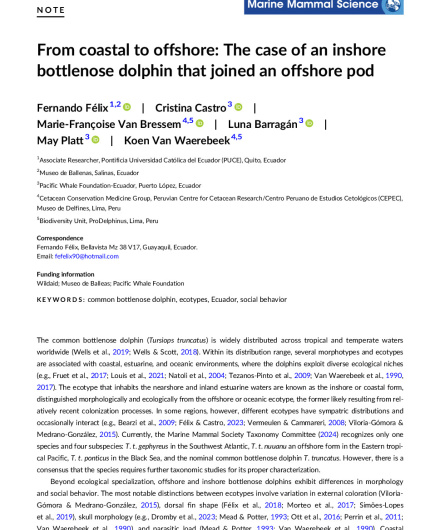
From coastal to offshore: The case of an inshore bottlenose...
The common bottlenose dolphin (Tursiops truncatus) is widely distributed across tropical and temperate waters worldwide (Wells et al...

Monitoreo de especies
Status, trends and conservation of global sea turtle populations
Sea turtles experienced myriad human impacts during the twentieth century that caused extreme mortality across all seven species. Extensive conservation...
Monitoreo de especies
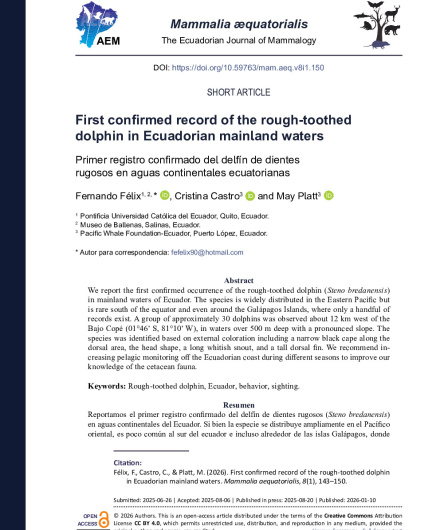
First confirmed record of the rough-toothed dolphin in ecuadorian mainland...
We report the first confirmed occurrence of the rough-toothed dolphin (Steno bredanensis) in mainland waters of Ecuador. The...