
Al descargar el documento usted acepta los términos establecidos en el copyright del documento y la política de uso de la plataforma.
Biblioteca
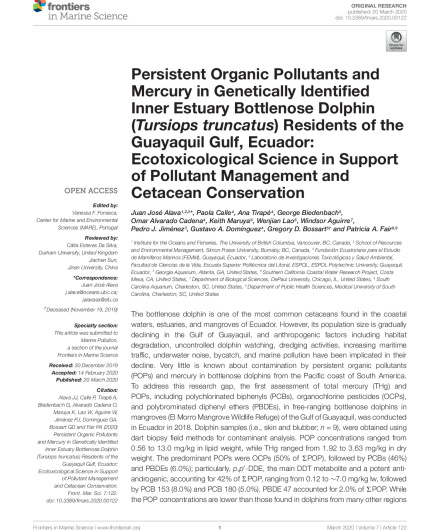
Persistent organic pollutants and mercury in genetically identified inner estuary bottlenose dolphin (Tursiops truncatus) residents of the Guayaquil Gulf, Ecuador: Ecotoxicological science in support of pollutant management and cetacean conservation

Gestión de áreas marinas
Servicios ecosistémicos
Año de la publicación:
2020
Autor:
Juan José Alava
Paola Calle
Ana Tirapé
George Biedenbach
Omar Alvarado Cadena
Keith Maruya
Wenjian Lao
Windsor Aguirre
Pedro J Jiménez
Gustavo A Domínguez
Gregory D Bossart
Patricia A Fair
Lugar de incidencia:
Ecuador
Región oceánica:
Pacífico - Sudeste
The bottlenose dolphin is one of the most common cetaceans found in the coastal waters, estuaries, and mangroves of Ecuador. However, its population size is gradually declining in the Gulf of Guayaquil, and anthropogenic factors including habitat degradation, uncontrolled dolphin watching, dredging activities, increasing maritime traffic, underwater noise, bycatch, and marine pollution have been implicated in their decline. Very little is known about contamination by persistent organic pollutants (POPs) and mercury in bottlenose dolphins from the Pacific coast of South America. To address this research gap, the first assessment of total mercury (THg) and POPs, including polychlorinated biphenyls (PCBs), organochlorine pesticides (OCPs), and polybrominated diphenyl ethers (PBDEs), in free-ranging bottlenose dolphins in mangroves (El Morro Mangrove Wildlife Refuge) of the Gulf of Guayaquil, was conducted in Ecuador in 2018. Dolphin samples (i.e., skin and blubber; n = 9), were obtained using dart biopsy field methods for contaminant analysis. POP concentrations ranged from 0.56 to 13.0 mg/kg in lipid weight, while THg ranged from 1.92 to 3.63 mg/kg in dry weight. The predominant POPs were OCPs (50% of ΣPOP), followed by PCBs (46%) and PBDEs (6.0%); particularly, p,p′-DDE, the main...
Etiquetas:
© 2020 Alava, Calle, Tirapé, Biedenbach, Alvarado Cadena, Maruya, Lao, Aguirre, Jiménez, Domínguez, Bossart and Fair. This is an open-access article distributed under the terms of the Creative Commons Attribution License (CC BY). The use, distribution or reproduction in other forums is permitted, provided the original author(s) and the copyright owner(s) are credited and that the original publication in this journal is cited, in accordance with accepted academic practice. No use, distribution or reproduction is permitted which does not comply with these terms.
La estructura de clasificación de la lista de especies Blue Five para la biblioteca digital ha sido
elaborada siguiendo criterios tanto científicos como de accesibilidad para facilitar la búsqueda de
información. En primer lugar, se organizaron las especies basándose en la taxonomía aceptada por la
comunidad científica para garantizar precisión y coherencia. Simultáneamente, se han implementado
categorías y subcategorías, considerando características morfológicas, su distribución y el uso de los
nombres comunes, con el fin de optimizar la navegación y búsqueda de datos por parte de los usuarios.
Esta metodología equilibrada asegura que la lista no solo sea científicamente rigurosa, sino también
fácil de consultar para quienes necesiten acceder a información específica de manera eficiente.
ISBN/ISSN/DOI:
doi: 10.3389/fmars.2020.00122
Editor:
Frontiers in Marine Science
Idioma:
Inglés
Fuente:
Frontiers in Marine Science
Especies mencionadas:
- Categoría Blue Five: Delfines
- Familia: Delfines
- Especies: Delfín nariz de botella (Tursiops truncatus)
Documentos relacionados:
Gestión de áreas marinas
Safeguarding marine life: conservation of biodiversity and ecosystems
Marine ecosystems and their associated biodiversity sustain life on Earth and hold intrinsic value. Critical marine ecosystem services include maintenance...
Gestión de áreas marinas
Revisiting "success" and "failure" of marine protected areas: a conservation...
Marine protected areas (MPAs) form the cornerstone of marine conservation. Identifying which factors contribute to their success or failure is...
Gestión de áreas marinas
Flotas de pesca extranjeras en el Pacífico costarricense y su...
Introducción: Hasta hoy, no ha sido analizado el esfuerzo pesquero por parte de flotas extranjeras en el Pacífico de Costa...