
Al descargar el documento usted acepta los términos establecidos en el copyright del documento y la política de uso de la plataforma.
Biblioteca
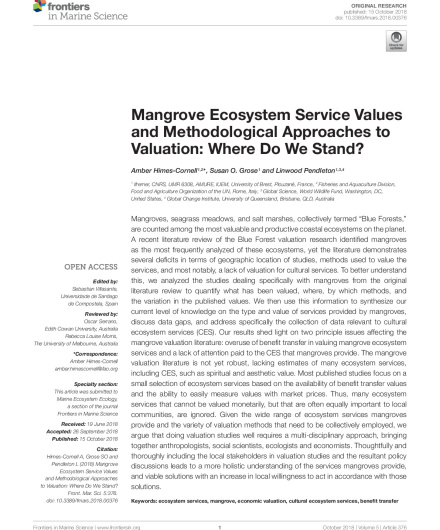
Mangrove ecosystem service values and methodological approaches to valuation: Where do we stand?

Gestión de áreas marinas
Servicios ecosistémicos
Año de la publicación:
2018
Autor:
Amber Himes Cornell
Susan O. Grose
Linwood Pendleton
Lugar de incidencia:
Global
Región oceánica:
Cosmopolita
Mangroves, seagrass meadows, and salt marshes, collectively termed “Blue Forests,” are counted among the most valuable and productive coastal ecosystems on the planet. A recent literature review of the Blue Forest valuation research identified mangroves as the most frequently analyzed of these ecosystems, yet the literature demonstrates several deficits in terms of geographic location of studies, methods used to value the services, and most notably, a lack of valuation for cultural services. To better understand this, we analyzed the studies dealing specifically with mangroves from the original literature review to quantify what has been valued, where, by which methods, and the variation in the published values. We then use this information to synthesize our current level of knowledge on the type and value of services provided by mangroves, discuss data gaps, and address specifically the collection of data relevant to cultural ecosystem services (CES). Our results shed light on two principle issues affecting the mangrove valuation literature: overuse of benefit transfer in valuing mangrove ecosystem services and a lack of attention paid to the CES that mangroves provide. The mangrove valuation literature is not yet robust, lacking estimates of many ecosystem services, including...
Etiquetas:
© 2018 Himes-Cornell, Grose and Pendleton. This is an open-access article distributed under the terms of the Creative Commons Attribution License (CC BY). The use, distribution or reproduction in other forums is permitted, provided the original author(s) and the copyright owner(s) are credited and that the original publication in this journal is cited, in accordance with accepted academic practice. No use, distribution or reproduction is permitted which does not comply with these terms.
La estructura de clasificación de la lista de especies Blue Five para la biblioteca digital ha sido
elaborada siguiendo criterios tanto científicos como de accesibilidad para facilitar la búsqueda de
información. En primer lugar, se organizaron las especies basándose en la taxonomía aceptada por la
comunidad científica para garantizar precisión y coherencia. Simultáneamente, se han implementado
categorías y subcategorías, considerando características morfológicas, su distribución y el uso de los
nombres comunes, con el fin de optimizar la navegación y búsqueda de datos por parte de los usuarios.
Esta metodología equilibrada asegura que la lista no solo sea científicamente rigurosa, sino también
fácil de consultar para quienes necesiten acceder a información específica de manera eficiente.
ISBN/ISSN/DOI:
doi: 10.3389/fmars.2018.00376
Editor:
Frontiers in Marine Science
Idioma:
Inglés
Fuente:
This article was submitted to Marine Ecosystem Ecology, a section of the journal Frontiers in Marine Science
Documentos relacionados:
Gestión de áreas marinas
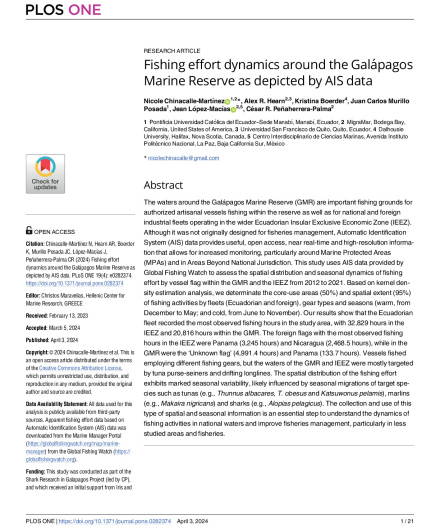
Fishing effort dynamics around the Galápagos Marine Reserve as depicted...
The waters around the Galápagos Marine Reserve (GMR) are important fishing grounds for authorized artisanal vessels fishing within the reserve...
Gestión de áreas marinas
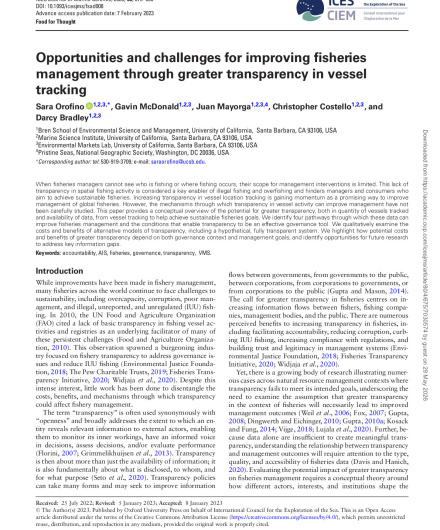
Opportunities and challenges for improving fisheries management through greater transparency...
When fisheries managers cannot see who is fishing or where fishing occurs, their scope for management interventions is limited. This...
Gestión de áreas marinas
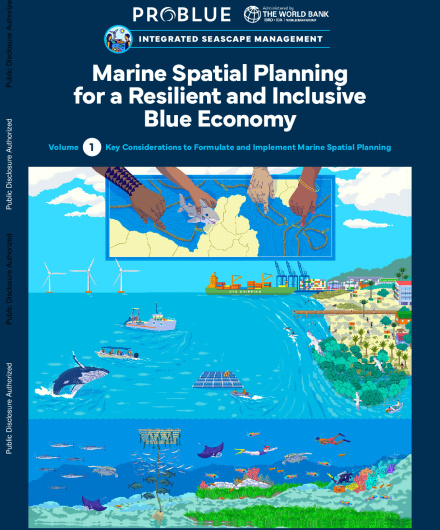
Marine spatial planning for a resilient and inclusive blue economy...
The World Bank defines the Blue Economy as the sustainable and integrated development of economic sectors in healthy oceans. It...