
Al descargar el documento usted acepta los términos establecidos en el copyright del documento y la política de uso de la plataforma.
Biblioteca
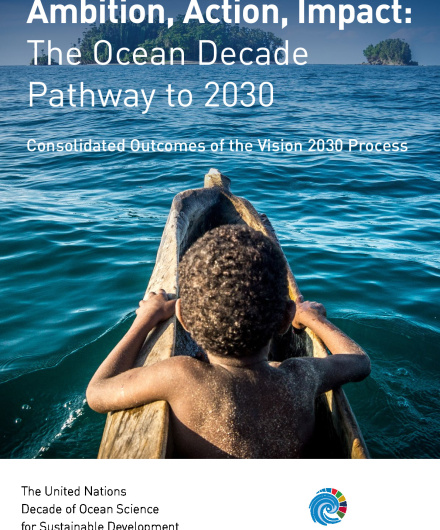
Ambition, Action, Impact: The Ocean Decade Pathway to 2030. Consolidated Outcomes of the Vision 2030 Process

Participación Internacional
Coordinación técnica
Año de la publicación:
2024
Autor:
Intergovernmental Oceanographic Commission of UNESCO
Lugar de incidencia:
Global
Región oceánica:
Cosmopolita
The proposal for a United Nations (UN) Decade of Ocean Science for Sustainable Development 2021-2030 (Ocean Decade) was first brought to the international community by UNESCO’s Intergovernmental Oceanographic Commission (UNESCO-IOC) in 2016 in a period where ocean science was largely invisible on the international policy landscape. While the 2030 Agenda included the major milestone of a Sustainable Development Goal (SDG) related to the ocean in the form of SDG14 - Life below water, there was little other recognition of the importance of the contribution of the ocean to the achievement of many of the other SDGs, and limited discussion of the role of the ocean, or ocean science, in achieving global aspirations for climate change, biodiversity conservation or food security just to name a few. Fast forward to 2024 and the context has radically changed, and the role of the ocean as a key influence in the condition of social, economic, and ecological systems has never been more visible. The recent adoption of the Agreement under the United Nations Convention on the Law of the Sea on the conservation and sustainable use of marine biological diversity of areas beyond national jurisdiction (BBNJ Agreement), the Ocean-Climate Dialogue under the United Nations Framework Convention on...
Etiquetas:
Salvo que se indique lo contrario, la licencia de este documento se describe como https://creativecommons.org/licenses/by-sa/3.0/igo
La estructura de clasificación de la lista de especies Blue Five para la biblioteca digital ha sido
elaborada siguiendo criterios tanto científicos como de accesibilidad para facilitar la búsqueda de
información. En primer lugar, se organizaron las especies basándose en la taxonomía aceptada por la
comunidad científica para garantizar precisión y coherencia. Simultáneamente, se han implementado
categorías y subcategorías, considerando características morfológicas, su distribución y el uso de los
nombres comunes, con el fin de optimizar la navegación y búsqueda de datos por parte de los usuarios.
Esta metodología equilibrada asegura que la lista no solo sea científicamente rigurosa, sino también
fácil de consultar para quienes necesiten acceder a información específica de manera eficiente.
Editor:
UNESCO-IOC
Idioma:
Inglés
Fuente:
AquaDocs
Documentos relacionados:
Participación Internacional
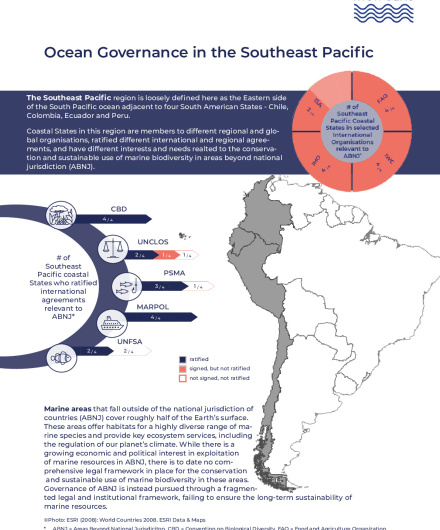
Ocean governance in the Southeast Pacific
The Southeast Pacific region is loosely defined here as the Eastern side of the South Pacific ocean adjacent to four...
Participación Internacional
I Encuentro virtual de buenas prácticas para el avistamiento de...
Desde la mesa de trabajo de turismo y con apoyo de la mesa de biodiversidad del Comité Técnico Nacional del...
Participación Internacional
The outlook for oceans, seas and marine resources in Latin...
In preparation for the launch of the United Nations Decade of Oceans Science for Sustainable Development 2021-2030, ECLAC seeks to...