
Al descargar el documento usted acepta los términos establecidos en el copyright del documento y la política de uso de la plataforma.
Biblioteca
Interbreeding area movement of an adult humpback whale between the east Pacific Ocean and southwest Indian Ocean

Monitoreo de especies
Metodologías de monitoreo
Año de la publicación:
2024
Autor:
Ekaterina Kalashnikova
Natalia Botero-Acosta
Esteban Duque Mesa
Mar Palanca Gascón
Patrick Lyne,
Ted Cheeseman
Alex Vogel
Amy Kennedy
Aylin Akkaya
Lugar de incidencia:
Global
Región oceánica:
Cosmopolita
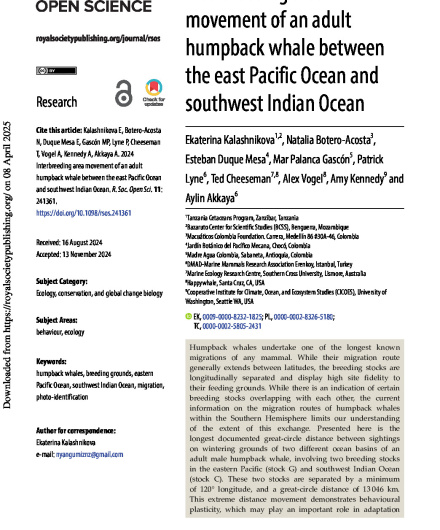
Humpback whales undertake one of the longest known migrations of any mammal. While their migration route generally extends between latitudes, the breeding stocks are longitudinally separated and display high site fidelity to their feeding grounds. While there is an indication of certain breeding stocks overlapping with each other, the current information on the migration routes of humpback whales within the Southern Hemisphere limits our understanding of the extent of this exchange. Presented here is the longest documented great-circle distance between sightings on wintering grounds of two different ocean basins of an adult male humpback whale, involving two breeding stocks in the eastern Pacific (stock G) and southwest Indian Ocean (stock C). These two stocks are separated by a minimum of 120° longitude, and a great-circle distance of 13 046 km. This extreme distance movement demonstrates behavioural plasticity, which may play an important role in adaptation strategies to global environmental changes and perhaps be an evolved response to various pressures, underlining the importance of consolidation of global datasets on wide-ranging marine mammals.
Etiquetas:
© 2024 The Authors.
Published by the Royal Society under the terms of the Creative Commons Attribution License http://creativecommons.org/licenses/by/4.0/, which permits unrestricted use, provided the original author and source are credited.
La estructura de clasificación de la lista de especies Blue Five para la biblioteca digital ha sido
elaborada siguiendo criterios tanto científicos como de accesibilidad para facilitar la búsqueda de
información. En primer lugar, se organizaron las especies basándose en la taxonomía aceptada por la
comunidad científica para garantizar precisión y coherencia. Simultáneamente, se han implementado
categorías y subcategorías, considerando características morfológicas, su distribución y el uso de los
nombres comunes, con el fin de optimizar la navegación y búsqueda de datos por parte de los usuarios.
Esta metodología equilibrada asegura que la lista no solo sea científicamente rigurosa, sino también
fácil de consultar para quienes necesiten acceder a información específica de manera eficiente.
Editor:
Royal Society
Idioma:
Inglés
Fuente:
Royal Society Open Science
Especies mencionadas:
- Categoría Blue Five: Ballenas Delfines
- Familia: Rocuales Delfines
- Especies: Ballena jorobada (Megaptera novaeangliae) Delfín nariz de botella (Tursiops truncatus)
Documentos relacionados:
Monitoreo de especies
Status, trends and conservation of global sea turtle populations
Sea turtles experienced myriad human impacts during the twentieth century that caused extreme mortality across all seven species. Extensive conservation...
Monitoreo de especies
First confirmed record of the rough-toothed dolphin in ecuadorian mainland...
We report the first confirmed occurrence of the rough-toothed dolphin (Steno bredanensis) in mainland waters of Ecuador. The...
Monitoreo de especies
Genomic signatures of migratory preference and historical whaling in eastern...
Understanding the genetic consequences of migratory behavior and drastic population contractions is essential for the conservation of baleen whales. Here...