
Al descargar el documento usted acepta los términos establecidos en el copyright del documento y la política de uso de la plataforma.
Biblioteca
First humpback whale movement between Ecuador and the South Sandwich Islands: Redefines the easternmost migration point of breeding stock G

Monitoreo de especies
Metodologías de monitoreo
Año de la publicación:
2023
Autor:
Cristina Castro
Marcia H Engel
Anthony R Martin
Lugar de incidencia:
Global
Región oceánica:
Cosmopolita
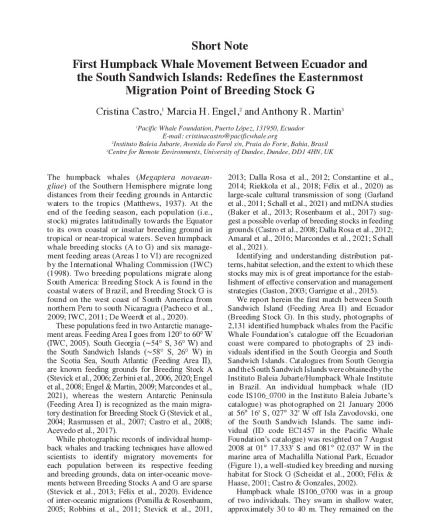
The humpback whales (Megaptera novaeangliae) of the Southern Hemisphere migrate long distances from their feeding grounds in Antarctic waters to the tropics (Matthews, 1937). At theend of the feeding season, each population (i.e., stock) migrates latitudinally towards the Equator to its own coastal or insular breeding ground in tropical or near-tropical waters. Seven humpback whale breeding stocks (A to G) and six management feeding areas (Areas I to VI) are recognized by the International Whaling Commission (IWC) (1998). Two breeding populations migrate along South America: Breeding Stock A is found in the coastal waters of Brazil, and Breeding Stock G is found on the west coast of South America from northern Peru to south Nicaragua (Pacheco et al., 2009; IWC, 2011; De Weerdt et al., 2020).
Etiquetas:
Aquatic Mammals
La estructura de clasificación de la lista de especies Blue Five para la biblioteca digital ha sido
elaborada siguiendo criterios tanto científicos como de accesibilidad para facilitar la búsqueda de
información. En primer lugar, se organizaron las especies basándose en la taxonomía aceptada por la
comunidad científica para garantizar precisión y coherencia. Simultáneamente, se han implementado
categorías y subcategorías, considerando características morfológicas, su distribución y el uso de los
nombres comunes, con el fin de optimizar la navegación y búsqueda de datos por parte de los usuarios.
Esta metodología equilibrada asegura que la lista no solo sea científicamente rigurosa, sino también
fácil de consultar para quienes necesiten acceder a información específica de manera eficiente.
ISBN/ISSN/DOI:
DOI 10.1578/AM.49.4.2023.382
Editor:
Aquatic Mammals
Idioma:
Inglés
Fuente:
Aquatic Mammals
Especies mencionadas:
- Categoría Blue Five: Ballenas
- Familia: Rocuales
- Especies: Ballena jorobada (Megaptera novaeangliae)
Documentos relacionados:
Monitoreo de especies
Status, trends and conservation of global sea turtle populations
Sea turtles experienced myriad human impacts during the twentieth century that caused extreme mortality across all seven species. Extensive conservation...
Monitoreo de especies
First confirmed record of the rough-toothed dolphin in ecuadorian mainland...
We report the first confirmed occurrence of the rough-toothed dolphin (Steno bredanensis) in mainland waters of Ecuador. The...
Monitoreo de especies
Genomic signatures of migratory preference and historical whaling in eastern...
Understanding the genetic consequences of migratory behavior and drastic population contractions is essential for the conservation of baleen whales. Here...