
Al descargar el documento usted acepta los términos establecidos en el copyright del documento y la política de uso de la plataforma.
Biblioteca
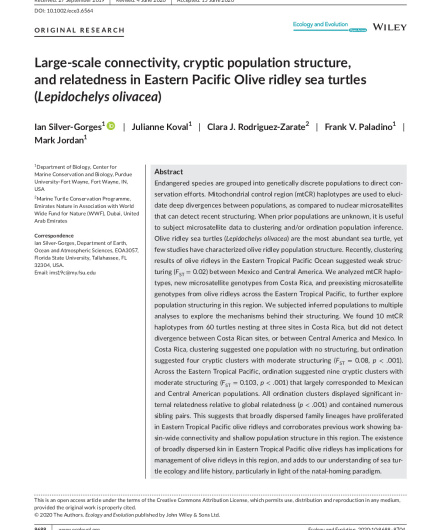
Large‐scale connectivity, cryptic population structure, and relatedness in Eastern Pacific olive ridley sea turtles (Lepidochelys olivacea)

Monitoreo de especies
Metodologías de monitoreo
Año de la publicación:
2020
Autor:
Ian Silver Gorges
Julianne Koval
Clara J. Rodriguez Zarate
Frank V. Paladino
Mark Jordan
Lugar de incidencia:
Regional
Región oceánica:
Pacífico - Centro Oriental
Endangered species are grouped into genetically discrete populations to direct conservation efforts. Mitochondrial control region (mtCR) haplotypes are used to elucidate deep divergences between populations, as compared to nuclear microsatellites that can detect recent structuring. When prior populations are unknown, it is useful to subject microsatellite data to clustering and/or ordination population inference.
Olive ridley sea turtles (Lepidochelys olivacea) are the most abundant sea turtle, yet few studies have characterized olive ridley population structure. Recently, clustering results of olive ridleys in the Eastern Tropical Pacific Ocean suggested weak structuring (FST = 0.02) between Mexico and Central America. We analyzed mtCR haplo types, new microsatellite genotypes from Costa Rica, and preexisting microsatellite genotypes from olive ridleys across the Eastern Tropical Pacific, to further explore population structuring in this region. We subjected inferred populations to multiple analyses to explore the mechanisms behind their structuring. We found 10 mtCR haplotypes from 60 turtles nesting at three sites in Costa Rica, but did not detect divergence between Costa Rican sites, or between Central America and Mexico. In Costa Rica, clustering suggested one population...
Etiquetas:
This is an open access article under the terms of the Creative Commons Attribution License, which permits use, distribution and reproduction in any medium, provided the original work is properly cited.
La estructura de clasificación de la lista de especies Blue Five para la biblioteca digital ha sido
elaborada siguiendo criterios tanto científicos como de accesibilidad para facilitar la búsqueda de
información. En primer lugar, se organizaron las especies basándose en la taxonomía aceptada por la
comunidad científica para garantizar precisión y coherencia. Simultáneamente, se han implementado
categorías y subcategorías, considerando características morfológicas, su distribución y el uso de los
nombres comunes, con el fin de optimizar la navegación y búsqueda de datos por parte de los usuarios.
Esta metodología equilibrada asegura que la lista no solo sea científicamente rigurosa, sino también
fácil de consultar para quienes necesiten acceder a información específica de manera eficiente.
ISBN/ISSN/DOI:
DOI: 10.1002/ece3.6564
Editor:
Ecology and Evolution/ John Wiley & Sons Ltd.
Idioma:
Inglés
Fuente:
Wiley
Especies mencionadas:
- Categoría Blue Five: Tortugas marinas
- Familia: Quelónidos
- Especies: Tortuga olivácea (Lepidochelys olivacea)
Documentos relacionados:
Monitoreo de especies
Status, trends and conservation of global sea turtle populations
Sea turtles experienced myriad human impacts during the twentieth century that caused extreme mortality across all seven species. Extensive conservation...
Monitoreo de especies
First confirmed record of the rough-toothed dolphin in ecuadorian mainland...
We report the first confirmed occurrence of the rough-toothed dolphin (Steno bredanensis) in mainland waters of Ecuador. The...
Monitoreo de especies
Genomic signatures of migratory preference and historical whaling in eastern...
Understanding the genetic consequences of migratory behavior and drastic population contractions is essential for the conservation of baleen whales. Here...