
Al descargar el documento usted acepta los términos establecidos en el copyright del documento y la política de uso de la plataforma.
Biblioteca
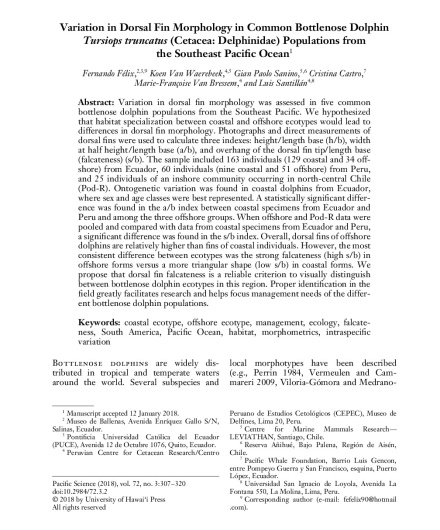
Variation in dorsal fin morphology in common bottlenose dolphin tursiops truncatus (cetacea: delphinidae) populations from the Southeast Pacific Ocean

Monitoreo de especies
Metodologías de monitoreo
Año de la publicación:
2018
Autor:
Fernando Félix
Koen Van Waerebeek
Gian Paolo Sanino
Cristina Castro
Marie Françoise Van Bressem
Luis Santillán
Lugar de incidencia:
Regional
Región oceánica:
Pacífico - Sudeste
We succinctly summarize population ID information for common bottlenose dolphins Tursiops truncatus of the Pacific coast of South America, covering four coastal range states. Phylogenetic uncertainties relate primarily to offshore vs. coastal (inshore) ecotypes and biogeographic borders between the five proposed populations (2 offshore, 3 coastal): Colombia-Ecuador Offshore stock (probably = ETP Offshore), Peru-Chile Offshore, Ecuador Coastal, Peru Coastal and an unique community (Pod-R) on the north-central coast of Chile. Main questions concern the extent of gene flow between the offshore stocks at one hand, and with -and between- the three coastal populations at the other hand. Seven cranial characters, four non-metric (separation of occipital condyles, pterygoid bone development, exostosis of periotic) and three metric (tooth width, antorbital process length, maximum width palatines), dorsal fin shape, body stockiness, mt-DNA (control region), habitat, prey composition, parasite load, behaviour and prevalence of some infectious diseases differentiate coastal from offshore forms. 'Pod-R' is the southernmost (29°15'S) and only confirmed coastal form community in Chilean waters, albeit with an offshore (falcate) dorsal fin. Bottlenose dolphins which regularly transit nearshore...
Etiquetas:
La estructura de clasificación de la lista de especies Blue Five para la biblioteca digital ha sido
elaborada siguiendo criterios tanto científicos como de accesibilidad para facilitar la búsqueda de
información. En primer lugar, se organizaron las especies basándose en la taxonomía aceptada por la
comunidad científica para garantizar precisión y coherencia. Simultáneamente, se han implementado
categorías y subcategorías, considerando características morfológicas, su distribución y el uso de los
nombres comunes, con el fin de optimizar la navegación y búsqueda de datos por parte de los usuarios.
Esta metodología equilibrada asegura que la lista no solo sea científicamente rigurosa, sino también
fácil de consultar para quienes necesiten acceder a información específica de manera eficiente.
Editor:
International Whaling Comission
Idioma:
Inglés
Fuente:
Pacific Whale Foundation
Especies mencionadas:
- Categoría Blue Five: Delfines
- Familia: Delfines
- Especies: Delfín nariz de botella (Tursiops truncatus)
Documentos relacionados:
Monitoreo de especies
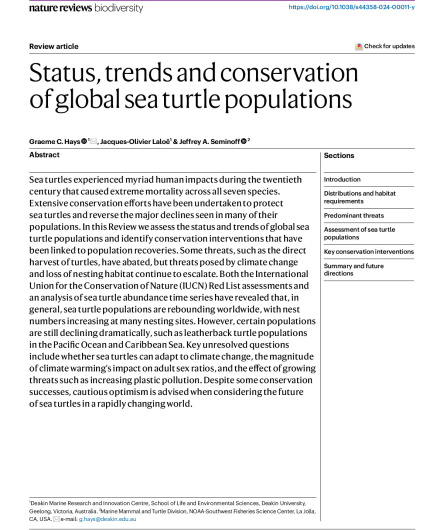
Status, trends and conservation of global sea turtle populations
Sea turtles experienced myriad human impacts during the twentieth century that caused extreme mortality across all seven species. Extensive conservation...
Monitoreo de especies
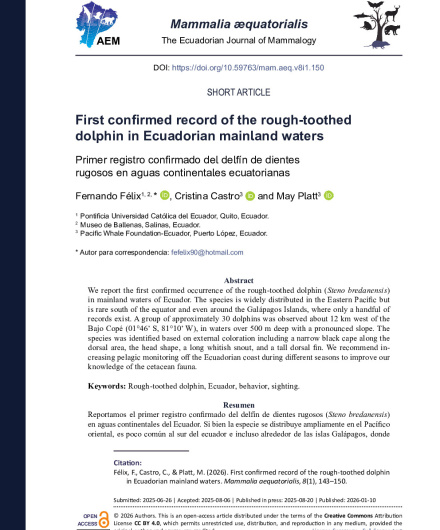
First confirmed record of the rough-toothed dolphin in ecuadorian mainland...
We report the first confirmed occurrence of the rough-toothed dolphin (Steno bredanensis) in mainland waters of Ecuador. The...
Monitoreo de especies
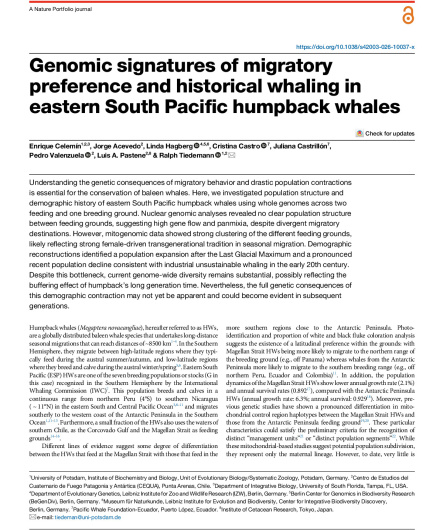
Genomic signatures of migratory preference and historical whaling in eastern...
Understanding the genetic consequences of migratory behavior and drastic population contractions is essential for the conservation of baleen whales. Here...