
Al descargar el documento usted acepta los términos establecidos en el copyright del documento y la política de uso de la plataforma.
Biblioteca
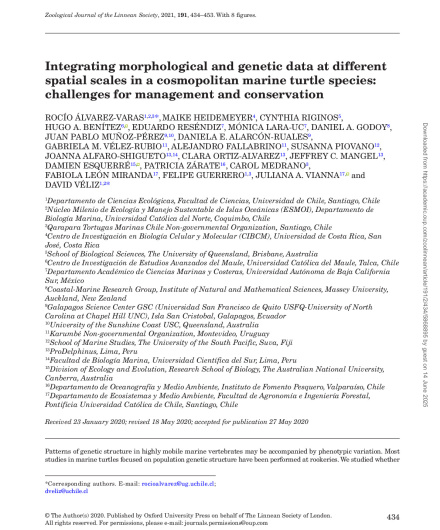
Integrating morphological and genetic data at different spatial scales in a cosmopolitan marine turtle species: challenges for management and conservation

Monitoreo de especies
Metodologías de monitoreo
Año de la publicación:
2020
Autor:
Rocío Álvarez-Varas
Maike Heidemeyer
Cynthia Riginos
Hugo A. Benítez
Eduardo Reséndiz
Mónica Lara-Uc
Daniel A. Godoy
Juan Pablo Muñoz-Pérez
Daniela E. Alarcón-Ruales
Gabriela M Vélez-Rubio [Et al.]
Lugar de incidencia:
Global
Región oceánica:
Cosmopolita
Patterns of genetic structure in highly mobile marine vertebrates may be accompanied by phenotypic variation. Most studies in marine turtles focused on population genetic structure have been performed at rookeries. We studied whether genetic and morphological variation of the endangered green turtle (Chelonia mydas) is consistent geographically, focusing on foraging grounds. An association between population genetic structure and body shape variation at broad (inter-lineage) and fine (foraging grounds) scales was predicted and analysed using mitochondrial DNA and geometric morphometrics. Although genetic and phenotypic differentiation patterns were congruent between lineages, no fine-scale association was found, suggesting adaptive divergence. Connectivity among Pacific foraging grounds found here suggests that temperatures of ocean surface currents may influence the genetic structure of C. mydas on a broad scale. Our results suggest that vicariance, dispersal, life-history traits and ecological conditions operating in foraging grounds have shaped the intraspecific morphology and genetic diversity of this species. Considering a range of geographic and temporal scales is useful when management strategies are required for cosmopolitan species. Integrating morphological and genetic...
Etiquetas:
Free Access
La estructura de clasificación de la lista de especies Blue Five para la biblioteca digital ha sido
elaborada siguiendo criterios tanto científicos como de accesibilidad para facilitar la búsqueda de
información. En primer lugar, se organizaron las especies basándose en la taxonomía aceptada por la
comunidad científica para garantizar precisión y coherencia. Simultáneamente, se han implementado
categorías y subcategorías, considerando características morfológicas, su distribución y el uso de los
nombres comunes, con el fin de optimizar la navegación y búsqueda de datos por parte de los usuarios.
Esta metodología equilibrada asegura que la lista no solo sea científicamente rigurosa, sino también
fácil de consultar para quienes necesiten acceder a información específica de manera eficiente.
ISBN/ISSN/DOI:
https://doi.org/10.1093/zoolinnean/zlaa066
Editor:
Zoological Journal of the Linnean Society
Idioma:
Inglés
Fuente:
Oxford Academic
Especies mencionadas:
- Categoría Blue Five: Tortugas marinas
- Familia: Quelónidos
- Especies: Tortuga verde (Chelonia mydas)
Documentos relacionados:
Monitoreo de especies
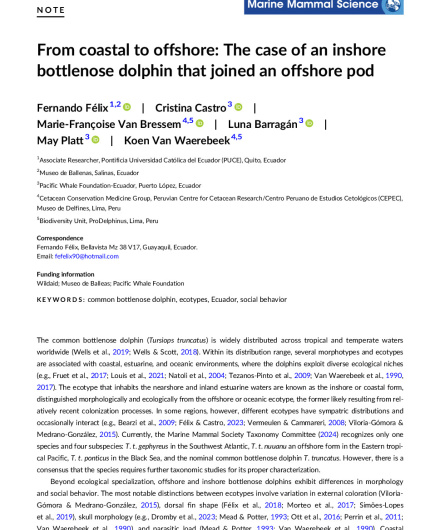
From coastal to offshore: The case of an inshore bottlenose...
"The common bottlenose dolphin (Tursiops truncatus) is widely distributed across tropical and temperate waters
worldwide (Wells et al...

Monitoreo de especies
Status, trends and conservation of global sea turtle populations
Sea turtles experienced myriad human impacts during the twentieth century that caused extreme mortality across all seven species. Extensive conservation...
Monitoreo de especies
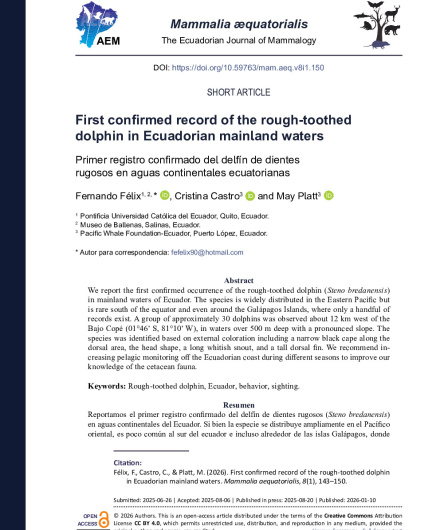
First confirmed record of the rough-toothed dolphin in ecuadorian mainland...
We report the first confirmed occurrence of the rough-toothed dolphin (Steno bredanensis) in mainland waters of Ecuador. The...