
Al descargar el documento usted acepta los términos establecidos en el copyright del documento y la política de uso de la plataforma.
Biblioteca
Priorities for ecological research on cetaceans in the Galápagos Islands


Monitoreo de especies
Metodologías de monitoreo
Año de la publicación:
2023
Autor:
Daniel M. Palacios
Mauricio Cantor
Lugar de incidencia:
Ecuador
Región oceánica:
Pacífico - Sudeste
Located in the eastern tropical Pacific, the Galápagos Islands are an oceanic insular ecosystem subject to strong environmental variability driven by local and regional processes. Past research has shown that such conditions can attract and sustain at least 23 cetacean species, out of which 14 are common, including nine Delphinids, one Ziphiid, one Physeterid, and three Balaenopterids. These species occupy both coastal and oceanic habitats, most are present year-round, and a few are migratory. However, research on cetaceans in Galápagos has been sporadic and chronically underfunded and is not currently considered a priority in the research agenda for Galápagos. Based on a review of existing information and an assessment of knowledge gaps, here we identify priorities for ecological research on cetaceans in Galápagos along five topical areas: 1) spatiotemporal occurrence, 2) population assessment, 3) health assessment, 4) social ecology, and 5) trophic ecology. Addressing these knowledge gaps will also help inform actions to preserve cetacean biodiversity and to manage human activities involving or affecting cetaceans in Galápagos. Given the logistical and funding challenges of conducting cetacean research in Galápagos, we recommend optimizing data sampling and accessibility via...
Etiquetas:
© 2023 Palacios and Cantor. This is an open-access article distributed under the terms of the Creative Commons Attribution License (CC BY). The use, distribution or reproduction in other forums is permitted, provided the original author(s) and the copyright owner(s) are credited and that the original publication in this journal is cited, in accordance with accepted academic practice. No use, distribution or reproduction is permitted which does not comply with these terms.
La estructura de clasificación de la lista de especies Blue Five para la biblioteca digital ha sido
elaborada siguiendo criterios tanto científicos como de accesibilidad para facilitar la búsqueda de
información. En primer lugar, se organizaron las especies basándose en la taxonomía aceptada por la
comunidad científica para garantizar precisión y coherencia. Simultáneamente, se han implementado
categorías y subcategorías, considerando características morfológicas, su distribución y el uso de los
nombres comunes, con el fin de optimizar la navegación y búsqueda de datos por parte de los usuarios.
Esta metodología equilibrada asegura que la lista no solo sea científicamente rigurosa, sino también
fácil de consultar para quienes necesiten acceder a información específica de manera eficiente.
ISBN/ISSN/DOI:
doi: 10.3389/fmars.2023.1084057
Editor:
Frontiers in Marine Science
Idioma:
Inglés
Fuente:
Marine Megafauna
Especies mencionadas:
- Categoría Blue Five: Ballenas Delfines
- Familia: Rocuales Delfines
- Especies: Ballena jorobada (Megaptera novaeangliae) Delfín común (Delphinus sp.) Delfín de Risso (Grampus griseus) Delfín moteado pantropical (Stenella attenuata) Delfín listado (Stenella coeruleoalba) Delfín girador (Stenella longirostris) Delfín nariz de botella (Tursiops truncatus) Ballena piloto de aleta corta (Globicephala macrorhynchus) Falsa orca (Pseudorca crassidens)
Documentos relacionados:
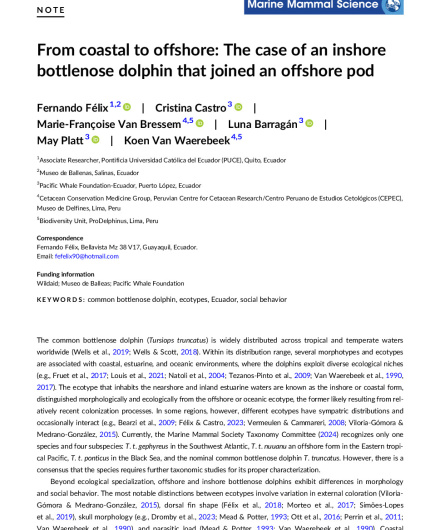
Monitoreo de especies
From coastal to offshore: The case of an inshore bottlenose...
"The common bottlenose dolphin (Tursiops truncatus) is widely distributed across tropical and temperate waters
worldwide (Wells et al...

Monitoreo de especies
Status, trends and conservation of global sea turtle populations
Sea turtles experienced myriad human impacts during the twentieth century that caused extreme mortality across all seven species. Extensive conservation...
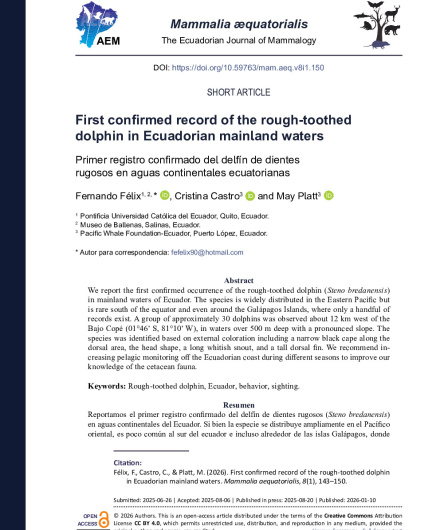
Monitoreo de especies
First confirmed record of the rough-toothed dolphin in ecuadorian mainland...
We report the first confirmed occurrence of the rough-toothed dolphin (Steno bredanensis) in mainland waters of Ecuador. The...