
Al descargar el documento usted acepta los términos establecidos en el copyright del documento y la política de uso de la plataforma.
Biblioteca
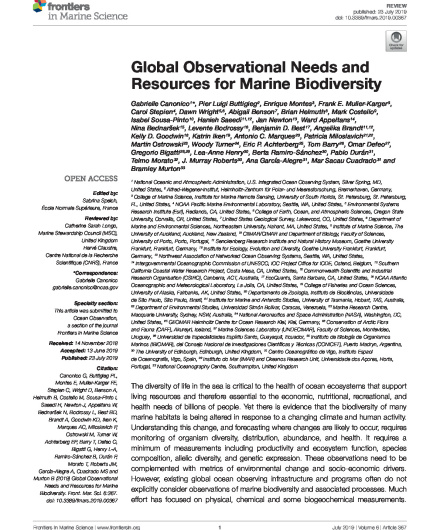
Global Observational Needs and Resources for Marine Biodiversity

Gestión de áreas marinas
Servicios ecosistémicos
Año de la publicación:
2019
Autor:
Gabrielle Canonico
Pier Luigi Buttigieg
Enrique Montes
Frank E. Muller-Karger
Carol Stepien
Dawn Wright
Abigail Benson
Brian Helmuth
Mark Costello
Isabel Sousa-Pinto
Hanieh Saeedi
Jan Newton
Ward Appeltans
Nina Bednaršek
Levente Bodrossy
Benjamin D. Best
Angelika Brandt
Kelly D. Goodwin
Katrin Iken
Antonio C. Marques
Patricia Miloslavich
Martin Ostrowski
Woody Turner
Eric P. Achterberg
Tom Barry
Omar Defeo
Gregorio Bigatti
Lea-Anne Henry
Berta Ramiro-Sánchez
Pablo Durán
Telmo Morato
J. Murray Roberts
Ana García-Alegre
Mar Sacau Cuadrado
Bramley Murton
Lugar de incidencia:
Global
Región oceánica:
Cosmopolita
The diversity of life in the sea is critical to the health of ocean ecosystems that support living resources and therefore essential to the economic, nutritional, recreational, and health needs of billions of people. Yet there is evidence that the biodiversity of many marine habitats is being altered in response to a changing climate and human activity. Understanding this change, and forecasting where changes are likely to occur, requires monitoring of organism diversity, distribution, abundance, and health. It requires a minimum of measurements including productivity and ecosystem function, species composition, allelic diversity, and genetic expression. These observations need to be complemented with metrics of environmental change and socio-economic drivers. However, existing global ocean observing infrastructure and programs often do not explicitly consider observations of marine biodiversity and associated processes. Much effort has focused on physical, chemical and some biogeochemical measurements. Broad partnerships, shared approaches, and best practices are now being organized to implement an integrated observing system that serves information to resource managers and decision-makers, scientists and educators, from local to global scales. This integrated observing system...
Etiquetas:
Copyright © 2019 Canonico, Buttigieg, Montes, Muller-Karger, Stepien, Wright, Benson, Helmuth, Costello, Sousa-Pinto, Saeedi, Newton, Appeltans, Bednaršek, Bodrossy, Best, Brandt, Goodwin, Iken, Marques, Miloslavich, Ostrowski, Turner, Achterberg, Barry, Defeo, Bigatti, Henry, Ramiro-Sánchez, Durán, Morato, Roberts, García-Alegre, Cuadrado and Murton. This is an open-access article distributed under the terms of the Creative Commons Attribution License (CC BY). The use, distribution or reproduction in other forums is permitted, provided the original author(s) and the copyright owner(s) are credited and that the original publication in this journal is cited, in accordance with accepted academic practice. No use, distribution or reproduction is permitted which does not comply with these terms.
La estructura de clasificación de la lista de especies Blue Five para la biblioteca digital ha sido
elaborada siguiendo criterios tanto científicos como de accesibilidad para facilitar la búsqueda de
información. En primer lugar, se organizaron las especies basándose en la taxonomía aceptada por la
comunidad científica para garantizar precisión y coherencia. Simultáneamente, se han implementado
categorías y subcategorías, considerando características morfológicas, su distribución y el uso de los
nombres comunes, con el fin de optimizar la navegación y búsqueda de datos por parte de los usuarios.
Esta metodología equilibrada asegura que la lista no solo sea científicamente rigurosa, sino también
fácil de consultar para quienes necesiten acceder a información específica de manera eficiente.
ISBN/ISSN/DOI:
https://doi.org/10.3389/fmars.2019.00367
Editor:
Frontiers in Marine Science
Idioma:
Inglés
Fuente:
Frontiers in Marine Science
Documentos relacionados:
Gestión de áreas marinas
Opportunities and challenges for improving fisheries management through greater transparency...
When fisheries managers cannot see who is fishing or where fishing occurs, their scope for management interventions is limited. This...
Gestión de áreas marinas
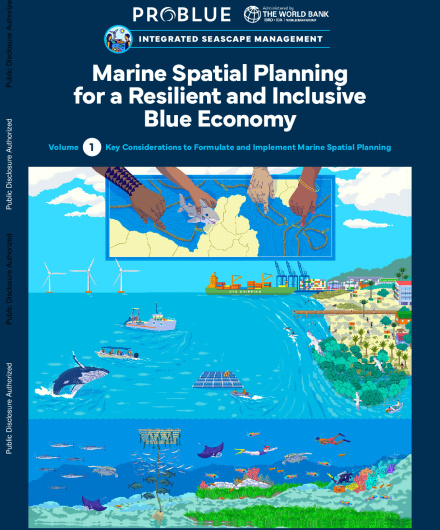
Marine spatial planning for a resilient and inclusive blue economy...
The World Bank defines the Blue Economy as the sustainable and integrated development of economic sectors in healthy oceans. It...
Gestión de áreas marinas
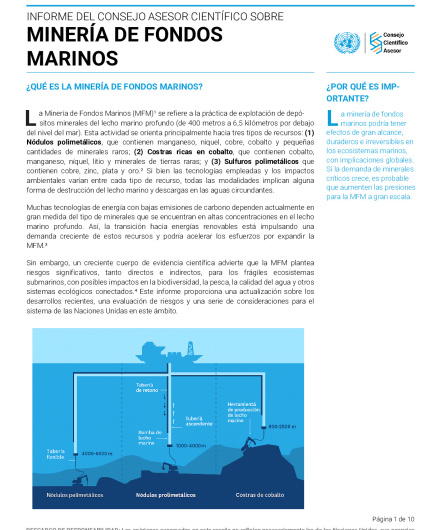
Informe del consejo asesor científico sobre minería de fondos marinos
Un creciente cuerpo de evidencia científica advierte que la MFM plantea riesgos significativos, tanto directos e indirectos, para los frágiles...