
Al descargar el documento usted acepta los términos establecidos en el copyright del documento y la política de uso de la plataforma.
Biblioteca
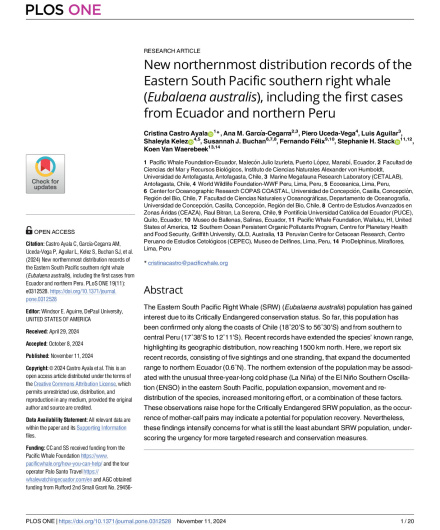
New northernmost distribution records of the Eastern South Pacific southern right whale (Eubalaena australis), including the first cases from Ecuador and northern Peru

Monitoreo de especies
Metodologías de monitoreo
Año de la publicación:
2024
Autor:
Cristina Castro Ayala
Ana M. García Cegarra
Piero Uceda Vega
Luis Aguilar, Shaleyla Kelez
Susannah J. Buchan
Fernando Félix
Stephanie H. Stack
Koen Van Waerebeek
Lugar de incidencia:
Chile
Ecuador
Perú
Región oceánica:
Pacífico - Sudeste
The Eastern South Pacific Right Whale (SRW) (Eubalaena australis) population has gained interest due to its Critically Endangered conservation status. So far, this population has been confirmed only along the coasts of Chile (18°20’S to 56°30’S) and from southern to central Peru (17°38’S to 12°11’S). Recent records have extended the species’ known range, highlighting its geographic distribution, now reaching 1500 km north. Here, we report six recent records, consisting of five sightings and one stranding, that expand the documented range to northern Ecuador (0.6°N). The northern extension of the population may be associated with the unusual three-year-long cold phase (La Niña) of the El Niño Southern Oscillation (ENSO) in the eastern South Pacific, population expansion, movement and re-distribution of the species, increased monitoring effort, or a combination of these factors. These observations raise hope for the Critically Endangered SRW population, as the occurrence of mother-calf pairs may indicate a potential for population recovery. Nevertheless, these findings intensify concerns for what is still the least abundant SRW population, underscoring the urgency for more targeted research and conservation measures.
Etiquetas:
Copyright: © 2024 Castro Ayala et al. This is an open access article distributed under the terms of the Creative Commons Attribution License, which permits unrestricted use, distribution, and reproduction in any medium, provided the original author and source are credited.
La estructura de clasificación de la lista de especies Blue Five para la biblioteca digital ha sido
elaborada siguiendo criterios tanto científicos como de accesibilidad para facilitar la búsqueda de
información. En primer lugar, se organizaron las especies basándose en la taxonomía aceptada por la
comunidad científica para garantizar precisión y coherencia. Simultáneamente, se han implementado
categorías y subcategorías, considerando características morfológicas, su distribución y el uso de los
nombres comunes, con el fin de optimizar la navegación y búsqueda de datos por parte de los usuarios.
Esta metodología equilibrada asegura que la lista no solo sea científicamente rigurosa, sino también
fácil de consultar para quienes necesiten acceder a información específica de manera eficiente.
ISBN/ISSN/DOI:
https://doi.org/10.1371/journal.pone.0312528
Editor:
PLoS ONE
Idioma:
Inglés
Fuente:
PLoS ONE
Especies mencionadas:
- Categoría Blue Five: Ballenas
- Familia: Ballenas francas
- Especies: Ballena franca austral (Eubalaena australis)
Documentos relacionados:
Monitoreo de especies
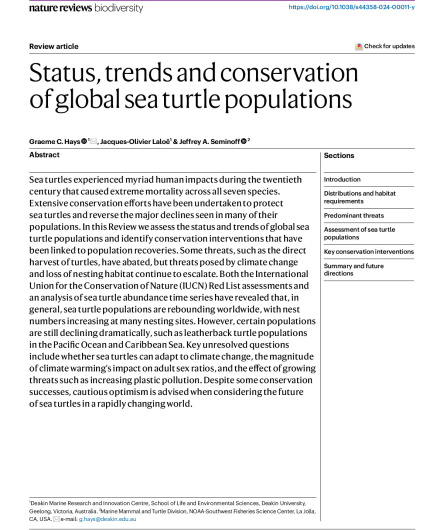
Status, trends and conservation of global sea turtle populations
Sea turtles experienced myriad human impacts during the twentieth century that caused extreme mortality across all seven species. Extensive conservation...
Monitoreo de especies
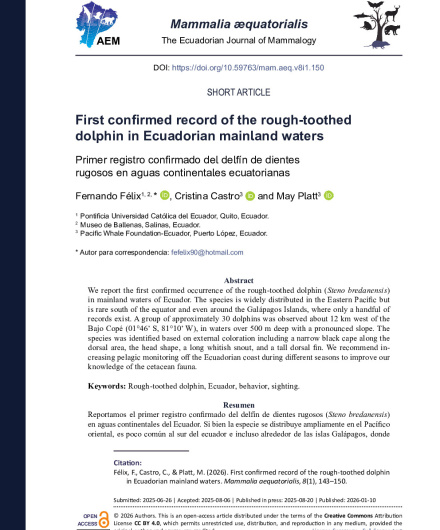
First confirmed record of the rough-toothed dolphin in ecuadorian mainland...
We report the first confirmed occurrence of the rough-toothed dolphin (Steno bredanensis) in mainland waters of Ecuador. The...
Monitoreo de especies
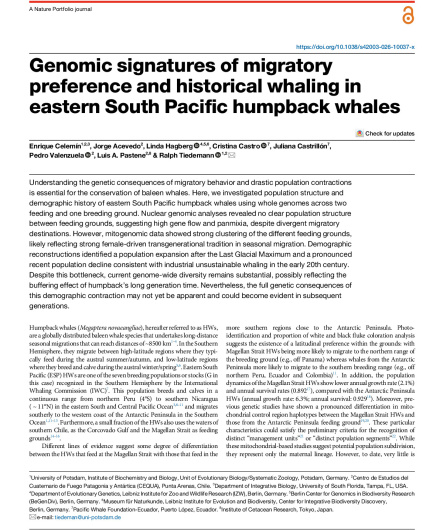
Genomic signatures of migratory preference and historical whaling in eastern...
Understanding the genetic consequences of migratory behavior and drastic population contractions is essential for the conservation of baleen whales. Here...