
Al descargar el documento usted acepta los términos establecidos en el copyright del documento y la política de uso de la plataforma.
Biblioteca
Depth-dependent diversity patterns of rocky subtidal macrobenthic communities along a temperate fjord in northern Chilean Patagonia

Gestión de áreas marinas
Servicios ecosistémicos
Año de la publicación:
2021
Autor:
Vicente I. Villalobos
Nelson Valdivia
Günter Försterra
Stacy Ballyram
Juan Pablo Espinoza
Jemma L. Wadham
Katherine Burgos-Andrade
Vreni Häussermann
Lugar de incidencia:
Chile
Región oceánica:
Pacífico - Sudeste
Understanding the distribution of biodiversity along environmental gradients allows us to predict how communities respond to natural and anthropogenic impacts. In fjord ecosystems, the overlap of strong salinity and temperature gradients provides us with the opportunity to assess the spatial variation of biodiversity along abiotic environmental gradients. However, in Northern Chilean Patagonia (NCP), a unique and at the same time threatened fjord system, the variation of macrobenthic communities along abiotic environmental gradients is still poorly known. Here, we tested whether macrobenthic species diversity and community structure followed systematic patterns of variation according to the spatial variation in salinity and temperature in Comau Fjord, NCP. A spatially extensive nested sampling design was used to quantify the abundance of subtidal macrobenthic species along the fjord axis (fjord sections: head, middle, and mouth) and a depth gradient (0–21 m). The vertical structure of the water column was strongly stratified at the head of the fjord, characterized by a superficial (depth to ca. 5 m) low-salinity and relatively colder layer that shallowed and decayed toward the mouth of the fjord. The biotic variation followed, in part, this abiotic spatial pattern. Species...
Etiquetas:
© 2021 Villalobos, Valdivia, Försterra, Ballyram, Espinoza, Wadham, Burgos-Andrade y Häussermann. Este es un artículo de acceso abierto distribuido bajo los términos de la Licencia Creative Commons Atribución (CC BY) . Se permite su uso, distribución y reproducción en otros foros, siempre que se cite al autor original y al titular de los derechos de autor, y se cite la publicación original en esta revista, de acuerdo con la práctica académica aceptada. No se permite ningún uso, distribución ni reproducción que no cumpla con estos términos.
La estructura de clasificación de la lista de especies Blue Five para la biblioteca digital ha sido
elaborada siguiendo criterios tanto científicos como de accesibilidad para facilitar la búsqueda de
información. En primer lugar, se organizaron las especies basándose en la taxonomía aceptada por la
comunidad científica para garantizar precisión y coherencia. Simultáneamente, se han implementado
categorías y subcategorías, considerando características morfológicas, su distribución y el uso de los
nombres comunes, con el fin de optimizar la navegación y búsqueda de datos por parte de los usuarios.
Esta metodología equilibrada asegura que la lista no solo sea científicamente rigurosa, sino también
fácil de consultar para quienes necesiten acceder a información específica de manera eficiente.
Editor:
Frontiers in Marine Science
Idioma:
Inglés
Fuente:
This article was submitted to Marine Ecosystem Ecology, a section of the journal Frontiers in Marine Science
Documentos relacionados:
Gestión de áreas marinas
Fishing effort dynamics around the Galápagos Marine Reserve as depicted...
The waters around the Galápagos Marine Reserve (GMR) are important fishing grounds for authorized artisanal vessels fishing within the reserve...
Gestión de áreas marinas
Opportunities and challenges for improving fisheries management through greater transparency...
When fisheries managers cannot see who is fishing or where fishing occurs, their scope for management interventions is limited. This...
Gestión de áreas marinas
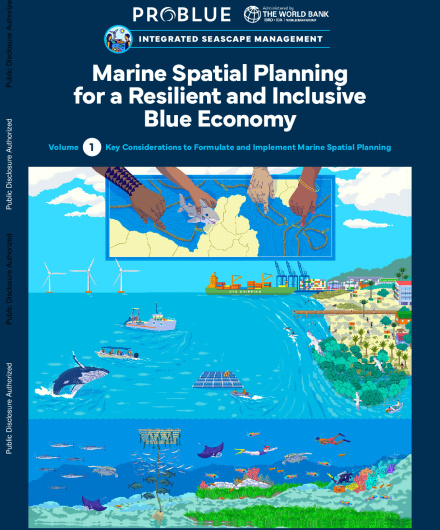
Marine spatial planning for a resilient and inclusive blue economy...
The World Bank defines the Blue Economy as the sustainable and integrated development of economic sectors in healthy oceans. It...