
Al descargar el documento usted acepta los términos establecidos en el copyright del documento y la política de uso de la plataforma.
Biblioteca
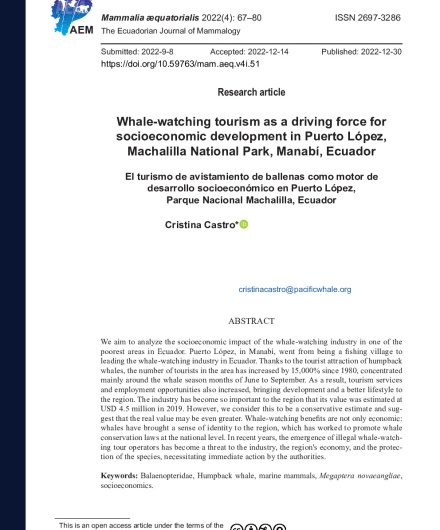
Whale-watching tourism as a driving force for socioeconomic development in Puerto López, Machalilla National Park, Manabí, Ecuador

Iniciativas sostenibles
Sectores productivos
Año de la publicación:
2022
Autor:
Cristina Castro
Juliana Castrillón
Wendy Gómez
Lugar de incidencia:
Ecuador
Región oceánica:
Pacífico - Sudeste
We aim to analyze the socioeconomic impact of the whale-watching industry in one of the poorest areas in Ecuador. Puerto López, in Manabí, went from being a fishing village to leading the whale-watching industry in Ecuador. Thanks to the tourist attraction of humpback whales, the number of tourists in the area has increased by 15,000% since 1980, concentrated mainly around the whale season months of June to September. As a result, tourism services and employment opportunities also increased, bringing development and a better lifestyle to the region. The industry has become so important to the region that its value was estimated at USD 4.5 million in 2019. However, we consider this to be a conservative estimate and suggest that the real value may be even greater. Whale-watching benefits are not only economic: whales have brought a sense of identity to the region, which has worked to promote whale conservation laws at the national level. In recent years, the emergence of illegal whale-watching tour operators has become a threat to the industry, the region's economy, and the protection of the species, necessitating immediate action by the authorities.
Etiquetas:
This is an open access article under the terms of the Creative Commons license: CC BY-NC-SA 4.0
La estructura de clasificación de la lista de especies Blue Five para la biblioteca digital ha sido
elaborada siguiendo criterios tanto científicos como de accesibilidad para facilitar la búsqueda de
información. En primer lugar, se organizaron las especies basándose en la taxonomía aceptada por la
comunidad científica para garantizar precisión y coherencia. Simultáneamente, se han implementado
categorías y subcategorías, considerando características morfológicas, su distribución y el uso de los
nombres comunes, con el fin de optimizar la navegación y búsqueda de datos por parte de los usuarios.
Esta metodología equilibrada asegura que la lista no solo sea científicamente rigurosa, sino también
fácil de consultar para quienes necesiten acceder a información específica de manera eficiente.
ISBN/ISSN/DOI:
https://doi.org/10.59763/mam.aeq.v4i.51
Editor:
Mammalia aequatorialis
Idioma:
Inglés
Fuente:
Mammalia aequatorialis
Especies mencionadas:
- Categoría Blue Five: Ballenas
- Familia: Rocuales
- Especies: Ballena azul (Balaenoptera musculus) Ballena jorobada (Megaptera novaeangliae)
Documentos relacionados:
Iniciativas sostenibles
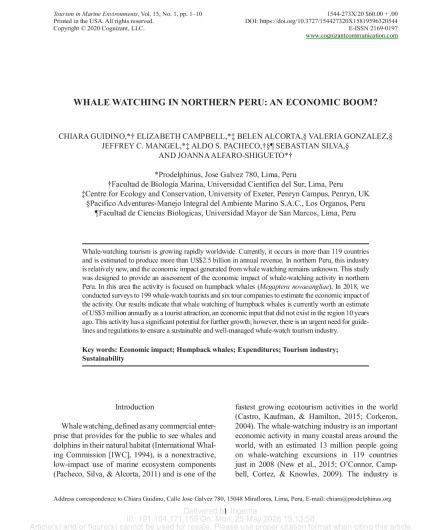
Whale watching in northern Peru: An economic boom?
Whale-watching tourism is growing rapidly worldwide. Currently, it occurs in more than 119 countries and is estimated to produce more...
Iniciativas sostenibles
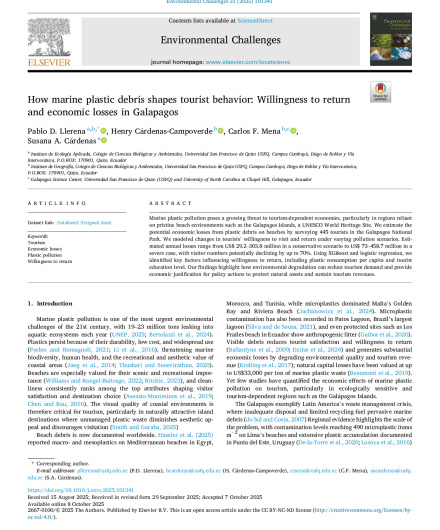
How marine plastic debris shapes tourist behavior: Willingness to return...
Marine plastic pollution poses a growing threat to tourism-dependent economies, particularly in regions reliant on pristine beach environments such as...
Iniciativas sostenibles
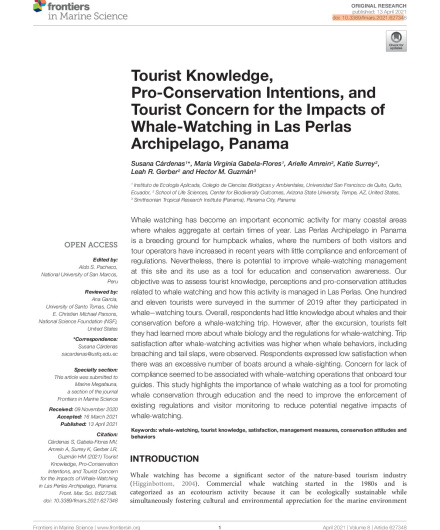
Tourist knowledge, pro-conservation intentions, and tourist concern for the impacts...
Whale watching has become an important economic activity for many coastal areas where whales aggregate at certain times of year...