
Al descargar el documento usted acepta los términos establecidos en el copyright del documento y la política de uso de la plataforma.
Biblioteca
First reported encounter of bryde’s whale and interaction with humpback whales in the Gulf of Tribugá, Chocó, northern colombian Pacific

Monitoreo de especies
Metodologías de monitoreo
Año de la publicación:
2022
Autor:
Ann Carole Vallejo
Dalia C. Barragán Barrera
Nohelia Farías Curtidor
Ashley Moss
Sara Castano
Jenny Bachmann
Edwin Gonzáles Murillo
Luis Antonio Lloreda
Yerson Gonzáles Murillo
Lugar de incidencia:
Colombia
Región oceánica:
Pacífico - Sudeste
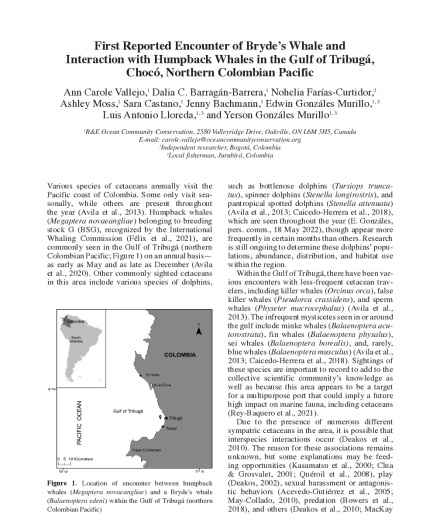
Various species of cetaceans annually visit the Pacific coast of Colombia. Some only visit sea-sonally, while others are present throughout the year (Avila et al., 2013). Humpback whales (Megaptera novaeangliae) belonging to breeding stock G (BSG), recognized by the International Whaling Commission (Félix et al., 2021), are commonly seen in the Gulf of Tribugá (northern Colombian Pacific; Figure 1) on an annual basis— as early as May and as late as December (Avila et al., 2020). Other commonly sighted cetaceans in this area include various species of dolphins, such as bottlenose dolphins (Tursiops truncatus), spinner dolphins (Stenella longirostris), and pantropical spotted dolphins (Stenella attenuata) (Avila et al., 2013; Caicedo-Herrera et al., 2018), which are seen throughout the year (E. Gonzáles, pers. comm., 18 May 2022), though appear more frequently in certain months than others. Research is still ongoing to determine these dolphins’ popu-lations, abundance, distribution, and habitat use within the region.
Etiquetas:
La estructura de clasificación de la lista de especies Blue Five para la biblioteca digital ha sido
elaborada siguiendo criterios tanto científicos como de accesibilidad para facilitar la búsqueda de
información. En primer lugar, se organizaron las especies basándose en la taxonomía aceptada por la
comunidad científica para garantizar precisión y coherencia. Simultáneamente, se han implementado
categorías y subcategorías, considerando características morfológicas, su distribución y el uso de los
nombres comunes, con el fin de optimizar la navegación y búsqueda de datos por parte de los usuarios.
Esta metodología equilibrada asegura que la lista no solo sea científicamente rigurosa, sino también
fácil de consultar para quienes necesiten acceder a información específica de manera eficiente.
ISBN/ISSN/DOI:
DOI 10.1578/AM.48.6.2022.753
Editor:
Aquatic Mammals
Idioma:
Inglés
Fuente:
Aquatic Mammals
Especies mencionadas:
- Categoría Blue Five: Ballenas Delfines
- Familia: Rocuales Delfines
- Especies: Ballena azul (Balaenoptera musculus) Ballena de Bryde (Balaenoptera edeni) Ballena jorobada (Megaptera novaeangliae) Delfín moteado pantropical (Stenella attenuata) Delfín girador (Stenella longirostris) Delfín nariz de botella (Tursiops truncatus) Orca (Orcinus orca)
Documentos relacionados:
Monitoreo de especies
Status, trends and conservation of global sea turtle populations
Sea turtles experienced myriad human impacts during the twentieth century that caused extreme mortality across all seven species. Extensive conservation...
Monitoreo de especies
First confirmed record of the rough-toothed dolphin in ecuadorian mainland...
We report the first confirmed occurrence of the rough-toothed dolphin (Steno bredanensis) in mainland waters of Ecuador. The...
Monitoreo de especies
Genomic signatures of migratory preference and historical whaling in eastern...
Understanding the genetic consequences of migratory behavior and drastic population contractions is essential for the conservation of baleen whales. Here...