
Al descargar el documento usted acepta los términos establecidos en el copyright del documento y la política de uso de la plataforma.
Biblioteca
Demographics and dynamics of the world's largest known population of oceanic manta rays Mobula birostris in coastal Ecuador


Monitoreo de especies
Metodologías de monitoreo
Año de la publicación:
2022
Autor:
Kanina Harty
Michel Guerrero
Anna M. Knochel
Guy M. W. Stevens
Andrea Marshall
Katherine Burgess
Joshua D. Stewart
Región oceánica:
Pacífico - Sudeste
Information on the life history and demographics of oceanic manta rays Mobula birostris remains scarce. Using photo-ID data, we describe the demographic structure, population size, and possible environmental drivers of the seasonal occurrence of M. birostris at Isla de la Plata and Bajo Copé, Ecuador. We identified a total of 2803 individuals from 3322 encounters over a period of 14 yr (2005-2018). The population sampled at these sites was significantly biased towards males (sex ratio 1F:1.67M) and only 12.9% of individuals were resighted. We used mark-resight models to estimate demographic parameters of the population, including superpopulation size, survival probability, entry/recruitment probability, and detection probability. We also evaluated how these parameters were related to environmental predictors, such as El Niño-Southern Oscillation (ENSO), sea surface temperature (SST), and chlorophyll a (chl a). Mark-resight analyses indicated that SST, chl a, time, and sex, but not ENSO, were important predictors of estimated population parameters. Entry probability peaked in 2012, which coincided with the lowest SST and highest chl a concentrations. The best-fit mark-resight model estimated a superpopulation size of 22316 individuals, with annual estimated abundances of 949-7650...
Etiquetas:
Open Access under Creative Commons by Attribution Licence. Use, distribution and reproduction are un - restricted. Authors and original publication must be credited.
La estructura de clasificación de la lista de especies Blue Five para la biblioteca digital ha sido
elaborada siguiendo criterios tanto científicos como de accesibilidad para facilitar la búsqueda de
información. En primer lugar, se organizaron las especies basándose en la taxonomía aceptada por la
comunidad científica para garantizar precisión y coherencia. Simultáneamente, se han implementado
categorías y subcategorías, considerando características morfológicas, su distribución y el uso de los
nombres comunes, con el fin de optimizar la navegación y búsqueda de datos por parte de los usuarios.
Esta metodología equilibrada asegura que la lista no solo sea científicamente rigurosa, sino también
fácil de consultar para quienes necesiten acceder a información específica de manera eficiente.
ISBN/ISSN/DOI:
https://doi.org/10.3354/meps14189
Editor:
Inter-Research · www.int-res.com
Idioma:
Inglés
Fuente:
Marine Ecology Progress Series Vol. 700: 145–159
Especies mencionadas:
- Categoría Blue Five: Mantarrayas
- Familia: Mantarrayas y móbulas
- Especies: Mantarraya gigante (Mobula birostris)
Documentos relacionados:
Monitoreo de especies
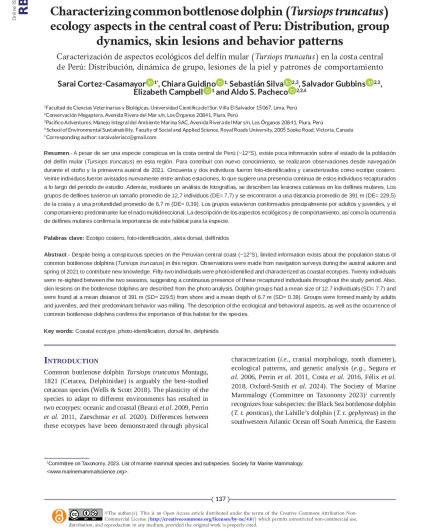
Characterizing common bottlenose dolphin (Tursiops truncatus) ecology aspects in the...
A pesar de ser una especie conspicua en la costa central de Perú (~12°S), existe poca información sobre el estado...
Monitoreo de especies
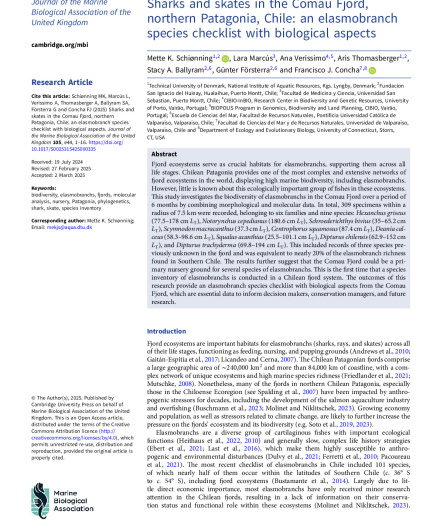
Sharks and skates in the Comau Fjord, northern Patagonia, Chile...
Fjord ecosystems serve as crucial habitats for elasmobranchs, supporting them across all life stages. Chilean Patagonia provides one of the...

Monitoreo de especies
Strandings and mortality of cetaceans due to interactions with fishing...
This preliminary note briefly reports on cetacean strandings and interactions with fishing nets (mostly gillnets) on the Ecuadorian coast. Between...